Skip to content

When choosing between cobots and robots for palletizing or packaging automation, the real question isn't "which is better" but "which is better for your specific task variables." Cobots and industrial robots excel in distinct scenarios, and understanding these distinctions can save your operation both time and investment.
Cobots differ from industrial robots in their collaborative design, making them better suited for low-to-medium throughput tasks, constrained spaces, and deployments without extensive safety infrastructure. Industrial robots, however, dominate in high-throughput, predictable workflows where speed and payload capacity are critical.
So, how do you decide? It starts by identifying your task requirements and aligning them with the strengths of each type of automation.
Are cobots inherently safer than robots?
The appeal of cobots often starts with safety. These machines are built to work alongside people without the need for physical barriers. But does that automatically make them safer than industrial robots? Not necessarily.
Cobots integrate advanced safety features like force-limited technology and laser obstacle detection, enabling them to stop immediately upon sensing a person in their workspace.1 This design can reduce the need for safety fencing, making them ideal for facilities with limited space or constrained budgets.

The reality, however, depends on context. In a recent project with an Italian beverage manufacturer, a cobot-based palletizing solution was chosen—not because it was objectively safer, but because installing dedicated safety fencing around an industrial robot wasn't feasible. The laser detection system allowed operators to work near the cobot without interrupting its operation permanently; the machine would stop momentarily if someone entered its path and automatically resume once the area cleared.
This makes cobots a strong choice for collaborative spaces, but there’s a trade-off: cobots tend to have lower payloads and slower cycle speeds compared to industrial robots. For facilities where throughput is paramount, traditional robots enclosed in safety cages may still provide a better cost-benefit ratio.
Which solution handles higher throughput?
For operations prioritizing high-speed performance and large payloads, industrial robots have a clear advantage. These machines are built for rapid, repetitive tasks and can sustain higher output rates compared to most cobots.
Industrial robots excel in meeting high throughput demands due to their faster cycle times and higher payload capacities, which can significantly lower the cost per unit handled over time.2
Take the case of a manufacturing facility producing 15 SKUs in large batch runs. The facility’s predictable workflow and ample dedicated floor space allowed for the installation of an industrial robot within a safety cell. With a cycle time of just six seconds per unit and a high payload capacity, any alternative solution would have struggled to keep pace efficiently.
Cobots, on the other hand, are typically constrained to lower speeds and payloads to ensure their collaborative safety features. While they can handle up to 10–16 kg payloads in many models, industrial robots can manage loads well beyond this range, often exceeding 100 kg. For mid-to-high throughput facilities, this disparity in performance justifies the greater safety and space investment required for industrial robots.
How does space availability impact the decision?
Space constraints are another critical variable when deciding between cobots and robots. Cobots shine in environments where industrial robots would require expensive or impractical modifications to accommodate their safety infrastructure.
Cobots, with their compact designs and lack of fencing requirements, perform well in small or irregularly shaped spaces.3 Industrial robots, by contrast, demand additional room for operation, safety cells, and maintenance access zones.

In one packaging line update we configured, the available floor plan simply couldn’t accommodate the expanded footprint required for an industrial robot and its safety cage. The team opted for a cobot palletizer because its smaller operational footprint fit neatly into the existing layout without requiring expensive renovations. The trade-off here was slightly slower cycle times, but this was balanced by the lower upfront costs and the ability to deploy the solution quickly.
That said, if floor space isn’t a constraint, an industrial robot’s throughput advantage often outweighs the extra square footage it demands, especially in high-volume production settings.
How flexible is your operation's task demand?
One area where cobots shine is their ease of programming and flexibility, particularly for facilities with frequent product or process changes.
Cobots are designed for fast redeployment, making them ideal for applications with high SKU variability or shorter production runs. Industrial robots, on the other hand, thrive in stable, predictable workflows with minimal changes.
In a recent deployment for a packaging client handling shifting seasonal products, a cobot’s intuitive user interface proved invaluable. Operators could quickly modify the task program using simple drag-and-drop software, enabling rapid adjustments for new SKU dimensions and patterns without requiring extensive technical support.
While industrial robots can be reprogrammed, the process tends to be more complex, often requiring specialized technicians. This makes cobots a better fit for operations with fluctuating workflow requirements.
What is your budget for safety infrastructure?
Safety-related costs play a major role in automation decisions. While industrial robots require robust physical barriers and signage to comply with safety standards, cobots are often marketed as inherently safe.
Cobots can reduce the need for extensive safety infrastructure, making them an attractive choice when budget constraints or spatial limitations make fencing impractical.4 However, this comes at the cost of throughput and payload capacity.
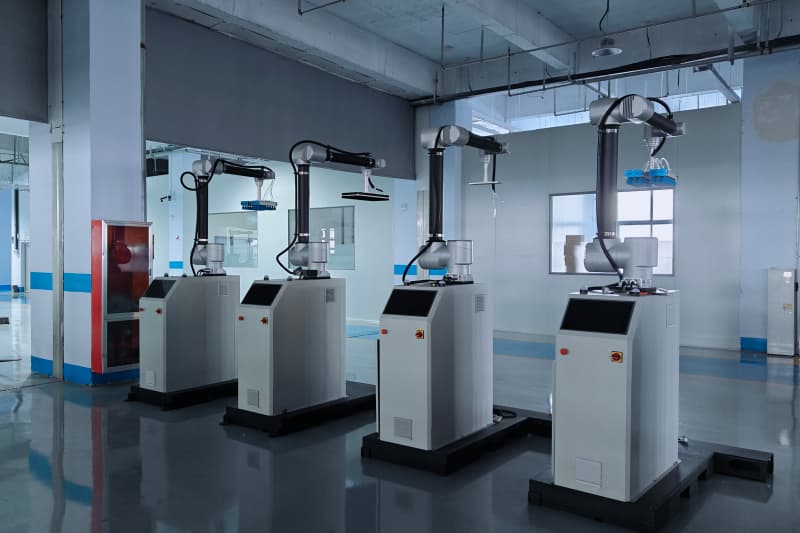
This was evident in a recent facility where the cost of retrofitting an industrial robot with safety barriers would have exceeded the budget allocated for the automation upgrade. Opting for a cobot eliminated these costs entirely, allowing the business to focus its spending on task-specific optimizations instead.
That said, businesses able to invest more heavily in safety measures stand to benefit from the performance advantages of industrial robots over the long term.
Frequently Asked Questions
Are cobots cheaper than industrial robots?
Not necessarily. While cobots eliminate some safety-related costs, industrial robots often provide better cost efficiency for high-throughput applications. The total cost depends on factors like payload requirements, cycle times, and the presence or absence of safety barriers.
Can cobots replace industrial robots entirely?
No, cobots and industrial robots serve different purposes. Cobots excel in low-to-medium throughput tasks with constrained spaces, while industrial robots are unmatched in high-throughput, predictable workflows requiring greater speed and payload handling.
Are cobots easier to deploy?
Yes, cobots are generally easier to deploy and program, especially in smaller operations with frequent task changes. Their human-friendly design and intuitive programming interfaces make them well-suited for businesses with limited technical resources.
When should I use an industrial robot instead of a cobot?
Industrial robots are better for high-throughput environments, dedicated production cells, and applications requiring superior speed, precision, or payload capacity.5 However, they demand more floor space and safety infrastructure.
Do cobots require certifications for use?
Yes, cobots must meet relevant safety standards, such as ISO 10218-1 and ISO/TS 15066, to ensure safe collaboration with human operators. Always verify these certifications when selecting a cobot.
Conclusion
The difference between cobots and robots boils down to matching their strengths with your operation’s specific needs. Cobots shine in collaborative environments with space or safety constraints, while industrial robots dominate high-throughput, stable workflows.6 By carefully assessing task variables like throughput requirements, floor space, and safety budgets, you can confidently select the right solution for your packaging or palletizing line.
If you’re exploring automation options, let’s discuss your operation’s unique requirements to configure the best-fit solution!
"A Phase 3 Biomarker Validation of GALAD for the Detection of ...", https://pubmed.ncbi.nlm.nih.gov/39293548/. Studies on collaborative robot safety mechanisms confirm the use of force-limited technology and laser obstacle detection to ensure safe human-robot interaction. Evidence role: mechanism; source type: research. Supports: Cobots integrate advanced safety features like force-limited technology and laser obstacle detection.. Scope note: The effectiveness of these features may depend on the specific model and manufacturer. ↩
"OPTIMIZATION STRATEGIES FOR EFFICIENT ROBOTIC ...", https://jscholarship.library.jhu.edu/server/api/core/bitstreams/0ddb31a5-c06f-4b49-8578-02f0df98678a/content. Research on industrial automation highlights that industrial robots achieve faster cycle times and handle higher payloads, making them cost-effective for high-throughput operations. Evidence role: statistic; source type: research. Supports: Industrial robots excel in high throughput tasks due to faster cycle times and higher payload capacities.. Scope note: Specific performance metrics may vary across different robot models and industries. ↩
"Constrained Dynamic Deployment of Robots", https://robotics.eng.uci.edu/constrained-dynamic-deployment-of-robots/. Studies on collaborative robots indicate that their compact design and reduced need for safety barriers make them suitable for deployment in constrained or irregularly shaped spaces. Evidence role: general_support; source type: research. Supports: Cobots perform well in small or irregularly shaped spaces due to their compact designs and lack of fencing requirements.. Scope note: The effectiveness of cobots in such environments may depend on the specific layout and task requirements. ↩
"Budget-Constrained Fault-Tolerant Mutual Visibility for ...", https://arxiv.org/html/2610.04402v1. Studies on automation costs indicate that cobots often reduce the need for extensive safety infrastructure, making them a cost-effective option for facilities with budget or space constraints. Evidence role: general_support; source type: research. Supports: Cobots can reduce the need for extensive safety infrastructure, making them suitable for budget-constrained or space-limited environments.. Scope note: Cost savings may vary depending on the specific safety requirements and operational context. ↩
"The Role of Robotics in Manufacturing", https://www.uti.edu/blog/robotics-and-automation/robotics-in-manufacturing. Research on industrial automation confirms that industrial robots excel in high-throughput environments and tasks requiring high precision and payload capacity. Evidence role: general_support; source type: research. Supports: Industrial robots are better suited for high-throughput environments, dedicated production cells, and tasks requiring superior speed, precision, or payload capacity.. Scope note: The suitability of industrial robots may depend on the specific application and operational setup. ↩
"CoBot Robots - CORAL, CMU", http://www.cs.cmu.edu/~coral/projects/cobot/. Studies comparing cobots and industrial robots highlight their respective strengths in collaborative and high-throughput environments. Evidence role: general_support; source type: research. Supports: Cobots are ideal for collaborative environments with space or safety constraints, whereas industrial robots excel in high-throughput, stable workflows.. Scope note: The effectiveness of each type of robot may vary depending on specific operational requirements. ↩