Skip to content

A flow wrap packing machine for sale may appear easy to compare until product sizes, film requirements, and package appearance enter the discussion. A low price can quickly become expensive if the machine does not fit every intended SKU. I recommend verifying the required packaging range first and requesting a matched configuration second.
A suitable flow wrap packing machine should cover the confirmed dimensions, shapes, films, and packaging requirements of your intended products. Before comparing quotations, list every SKU, provide product dimensions and photos or samples, and define the required bag size and appearance. A supplier can then verify the adjustment range and recommend an application-specific configuration.
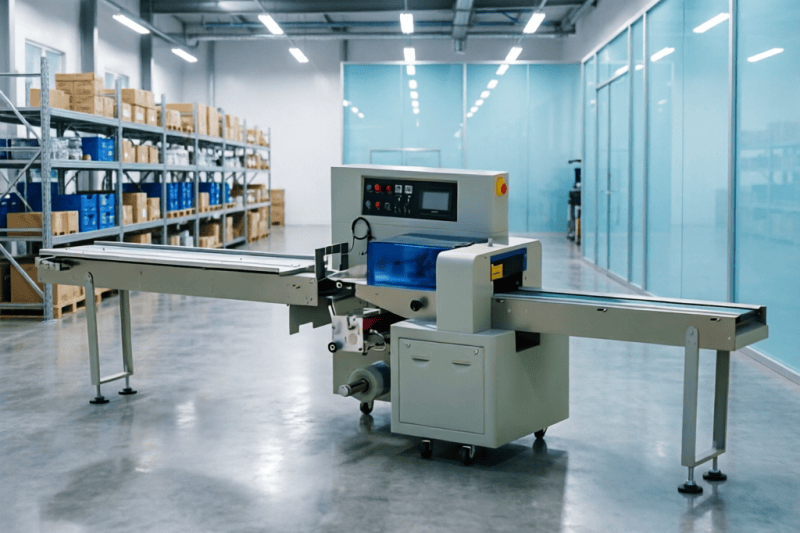
I have handled overseas inquiries from food, daily-goods, and hardware manufacturers, as well as machinery distributors. In my experience, the central question is not simply, “What does the machine cost?” The better question is, “Can this configuration reliably accommodate my confirmed product range?”
What Should You Check Before Buying a Flow Wrap Packing Machine for Sale?
Buyers sometimes ask for a price before sharing enough product information. This approach feels efficient, but it often produces a quotation based on assumptions. Those assumptions can cause sizing errors, unnecessary options, or a machine that cannot produce the expected package. I start by defining the application.
A buyer should check product dimensions, shape, orientation, bag dimensions, film type, feeding method, required package appearance, and expected production conditions. The supplier should use this information to identify a suitable machine size, forming system, sealing arrangement, controls, and optional functions before issuing a meaningful quotation.

Start with the product, not the machine model
I usually ask buyers to provide details for every product they plan to package, rather than one representative item. A complete product schedule should include:
- Product name or SKU
- Product length, width, and height
- Product shape and orientation
- Minimum and maximum dimensions
- Product weight
- Product photos from several angles
- Samples, when practical
- Required bag length and width
- Film type and thickness, if already selected
- Printed or unprinted film requirements
- Preferred seal position
- Expected packaging appearance
- Current or target packaging process
- Available electrical supply
- Factory space and line layout
- Connection requirements for upstream or downstream equipment
Product dimensions alone do not always tell the full story. A soft bakery product, a rigid hardware component, and a group of stacked daily-use items may have similar outer measurements, but they can behave very differently during feeding, film forming, and sealing.1
Distinguish product dimensions from bag dimensions
I often see inquiries that provide only the product length. However, a flow wrapper must form film around the product and create longitudinal and end seals.2 The finished bag dimensions therefore depend on more than the nominal product measurements.
The supplier may need to account for:
- Clearance around the product
- Product height and irregular edges
- End-seal space
- Film behavior
- Required package tightness
- Product movement during feeding
- Printed film registration
- The desired position of the longitudinal seal
A buyer should avoid estimating the final bag width without checking the forming method. A supplier should calculate or test the proposed bag dimensions based on the actual product and film.
Use a requirements table
I recommend organizing product information in a simple table.
| SKU | Product dimensions, L × W × H | Shape | Required bag size | Film | Notes |
|---|---|---|---|---|---|
| Product A | Buyer to provide | Regular or irregular | Buyer or supplier to confirm | Printed or plain | Orientation required |
| Product B | Buyer to provide | Regular or irregular | Buyer or supplier to confirm | Printed or plain | Fragile or rigid |
| Product C | Buyer to provide | Regular or irregular | Buyer or supplier to confirm | Printed or plain | Manual or automatic feed |
This document helps the supplier assess the complete range. It also creates a useful reference when the buyer compares several proposals.
I treat a quotation without confirmed product data as an initial budget indication, not a final equipment recommendation.
Can One Flow Wrap Packing Machine Handle Multiple Products?
Factories often assume that every product size requires a separate machine. The opposite assumption can be just as risky. A standard machine does not automatically package every item. I determine whether products can share one machine by comparing their full packaging requirements with the machine’s verified adjustment range.
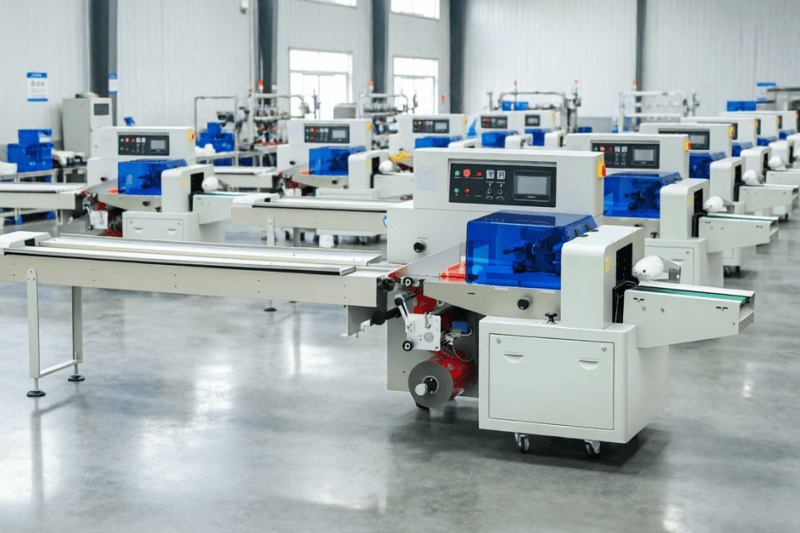
One flow wrapper can package multiple products when their dimensions, shapes, bag sizes, films, feeding requirements, and sealing conditions fall within a confirmed compatible range. The supplier should review every SKU and identify necessary change parts or adjustments. Buyers should not rely on a general statement that the machine is “fully adjustable.”
What an adjustable range actually means
The phrase “one machine for multiple products” needs clear limits. The machine may allow an operator to adjust bag length, product pitch, and certain guide positions. However, other changes may require different forming boxes, film rolls, feeding components, or sealing parts.
The following factors determine whether products can share a machine:
-
Product width and height:
The film-forming components must accommodate the product cross-section and the required bag width. -
Product length:
The controls and sealing cycle must support the required bag length while maintaining suitable spacing between products. -
Product shape:
A regular biscuit and an irregular hardware assembly may require different guides or feeding arrangements, even if their dimensions are similar. -
Film specification:
Different films can require different sealing temperatures, dwell conditions, or sealing systems.3 The supplier should confirm material compatibility. -
Feeding method:
Manual placement, automatic feeding, and connection to an upstream line create different control and synchronization requirements.4 -
Package presentation:
Printed-film registration, seal position, package tightness, and product orientation can affect the configuration.5
A bounded example from an Australian biscuit project
I once handled an inquiry from an Australian biscuit manufacturer with several biscuit sizes. The buyer initially expected to purchase different machines because the products did not share identical dimensions.
I collected the dimensions for each confirmed biscuit, reviewed the requested bag sizes, and compared the full range with the proposed machine’s adjustment capabilities. The review indicated that one adjustable flow wrapper could cover the assessed biscuit range. The customer therefore selected one machine rather than separate units for those products.
The buyer later reported positive use of the equipment. However, I do not treat that result as a universal rule. The conclusion applied to the biscuit dimensions, packaging requirements, and configuration reviewed for that project. A wider product, a taller stack, a different film, or another feeding arrangement might have changed the recommendation.
Separate proven flexibility from vague flexibility
| Supplier statement | What it means for procurement |
|---|---|
| “The machine can pack many products.” | The statement remains unverified without SKU data. |
| “These listed SKUs fall within the proposed range.” | The statement provides a useful starting point. |
| “Product C needs another forming box.” | The quotation should identify the change part and procedure. |
| “We tested your samples and recorded the result.” | The buyer can review stronger application evidence. |
| “This machine can pack everything.” | The buyer should request precise limits and proof. |
I recommend asking the supplier to mark each SKU as confirmed, conditionally compatible, or not recommended. This simple classification exposes uncertainty before purchase.
What Information Is Needed to Quote a Flow Wrap Packing Machine for Sale?
A request that says only “Please send your best price” does not provide enough information for responsible selection. The supplier may answer with a generic figure, but that figure can exclude essential components. I prefer to qualify the application before discussing a final machine price.
An accurate quotation requires a complete SKU list, product dimensions and photos, sample availability, bag specifications, film information, feeding method, target output, electrical standards, line-integration needs, and customization requirements. The supplier can then define the machine model, included equipment, exclusions, testing method, delivery scope, and commercial terms.
Why fixed online prices can be misleading
A flow wrap packing machine for sale is usually quoted according to its configuration and project scope. Two machines with similar external frames may have different film widths, sealing systems, controls, feeding devices, guarding, coding equipment, and integration requirements.
The final amount may be influenced by:
- Machine size and supported packaging range
- Film width and forming components
- Manual, semi-automatic, or integrated feeding
- Printed-film registration
- Date coding or labeling equipment
- Gas-flushing requirements, if applicable
- Special sealing or cutting arrangements
- Electrical components and local power standards
- Safety guarding
- Upstream and downstream conveyors
- Custom interfaces
- Factory testing requirements
- Shipping terms and destination
- Installation, commissioning, and training scope
I advise buyers to compare the scope behind the price, rather than comparing only the total amount.
Build a quotation request that suppliers can answer
A practical request for quotation can follow this structure:
-
List all products.
Include minimum and maximum dimensions for each SKU. -
Attach clear photographs.
Show the product, current package, desired package, and product orientation. -
State bag requirements.
Include known bag dimensions, seal preferences, printed-film requirements, and appearance expectations. -
Describe the operating process.
Explain whether workers will place products manually or whether the wrapper must connect to another machine. -
Define the expected output.
Provide a realistic target based on upstream supply and downstream handling. The supplier should confirm performance through application-specific evaluation rather than unsupported general figures. -
Describe the site.
State electrical supply, available floor space, environmental considerations, and line direction. -
Request a documented scope.
Ask the supplier to identify included components, optional items, exclusions, lead time, warranty, testing, and support.
How Should Buyers Verify a Flow Wrapper’s Adjustment Range?
A specification sheet may show minimum and maximum values, but those values do not always prove that every combination between them is suitable. Buyers need evidence that the proposed setup can handle their actual products. I recommend a structured review that connects every SKU to specific machine adjustments.
Buyers should verify the packaging range through dimensional review, configuration records, sample testing where feasible, and documented test results. The review should cover product fit, bag formation, seal appearance, cutting position, feeding stability, changeover needs, and compatibility with the selected film. Qualified specialists should evaluate unusual or regulated applications.

Do not evaluate maximum values in isolation
A machine may support a stated maximum product width and a stated maximum product height, but it may not support both maximums at the same time.6 The forming area, film width, seal geometry, and product clearances interact.
I suggest asking these questions:
- Can the proposed forming set accommodate each product cross-section?
- Does the quoted film width suit every required bag?
- Does the bag length range cover the shortest and longest products?
- Does the control system support the required printed-film registration?
- Does any SKU require a dedicated forming box?
- Can the operator complete changeovers with standard tools?
- Which settings must change between products?
- Does the supplier provide setup records for each SKU?
- Has the supplier evaluated the selected film?
- Does the proposed feeder handle each product shape and orientation?
Request a product-to-configuration matrix
A matrix makes the recommendation more specific.
| Product | Machine suitability | Change required | Verification method |
|---|---|---|---|
| SKU A | Confirmed or pending | Guide and setting adjustment | Drawing or sample test |
| SKU B | Confirmed or pending | Forming set change | Sample test recommended |
| SKU C | Confirmed or pending | Feeding modification | Engineering review |
| SKU D | Not recommended if outside range | Different model may be needed | Revised selection |
The supplier should explain any pending item. A buyer should not interpret silence as confirmation.
Use samples when the risk justifies them
Photos and dimensions can support an initial assessment, but samples provide better evidence for fragile, irregular, flexible, sticky, or unstable products.7 Samples also help the supplier examine how an item enters the film tube and passes through the sealing area.
When shipping samples is practical, I recommend that the buyer and supplier agree on:
- The number of samples
- The film used for testing
- The required bag dimensions
- Acceptance criteria
- The product orientation
- The expected appearance
- The video angles and test records
- The handling of unused samples
A test video can show the machine operating, but it does not replace a defined acceptance standard.8 The buyer should review whether the video shows the correct product, film, settings, and finished package.
Food-contact, electrical, machine-safety, and market-access requirements may also apply.9 Buyers should ask for the relevant declarations and certification documents, verify their scope and validity, and consult qualified compliance professionals for the destination market.
How Do You Compare Suppliers Offering a Flow Wrap Packing Machine for Sale?
A polished brochure does not prove that a supplier understands your products. A low quotation does not prove that the scope is complete. I compare suppliers by examining how they collect requirements, define limitations, document configurations, conduct testing, and support the buyer after shipment.
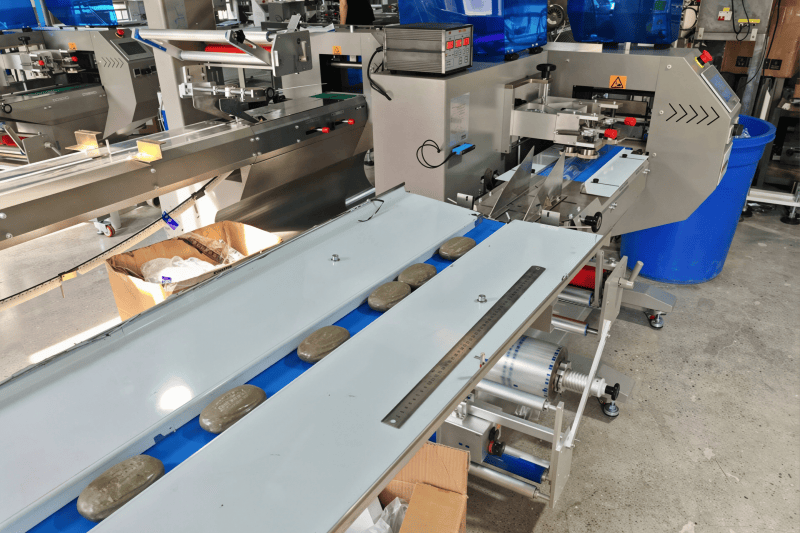
A capable supplier should ask detailed application questions, explain the verified adjustment range, identify change parts, document quotation inclusions, and provide an agreed testing process. Buyers should also assess manufacturing and integration responsibility, component selection, warranty conditions, technical support, spare-parts availability, and experience with export documentation.
Evaluate the quality of the supplier’s questions
I view detailed questions as a positive sign. A responsible supplier may delay the final quotation until the application is clear. This approach protects both sides.
The supplier should ask about:
- Every intended SKU
- Product dimensions and tolerances
- Product condition and fragility
- Required package dimensions
- Film structure and roll details
- Feeding and line integration
- Local voltage and frequency
- Safety and compliance expectations
- Installation conditions
- Operator experience
- Spare-parts expectations
- Acceptance testing
A supplier who asks only for the maximum product size may overlook important differences between SKUs.
Clarify who makes and integrates each part
Some packaging machinery suppliers manufacture core equipment internally and source or integrate other components. This production model is not automatically good or bad. The buyer needs clarity about responsibility.10
I recommend asking:
- Which equipment does the supplier manufacture?
- Which units come from partner manufacturers?
- Who controls the complete system design?
- Who performs integration and testing?
- Who provides the warranty for bought-in components?
- Who handles technical questions after delivery?
- Which international-brand components are included?
- Can the supplier identify component models in the final configuration?
Our own supply model combines internal production with external integration according to the machine type and project. We use international-brand components where specified, but buyers should confirm exact brands and models in the quotation because configurations can vary.
Review service as a defined scope
A promise of “good after-sales service” is too broad for procurement. The contract should state what the service includes.
| Service area | Point to confirm |
|---|---|
| Factory testing | Products, film, duration, and acceptance criteria |
| Test documentation | Video, photos, settings, and sample package |
| Warranty | Duration, covered parts, exclusions, and claim process |
| Remote support | Communication method and available hours |
| On-site service | Availability, travel costs, and responsibilities |
| Installation | Supplier and buyer responsibilities |
| Training | Operator and maintenance topics |
| Spare parts | Recommended list, prices, and delivery options |
I also recommend checking company registration, export history, references where available, and the proposed inspection process. Buyers should treat certificates as documents to verify rather than as automatic proof of suitability. An independent inspection or qualified engineering review may be appropriate for high-value or integrated projects.
Frequently Asked Questions
How much does a flow wrap packing machine cost?
The price depends on product dimensions, bag range, film, feeding method, controls, optional equipment, customization, and line integration. I recommend providing a complete SKU list before requesting a final price. A generic figure can support early budgeting, but it should not replace a matched technical and commercial quotation.
Can one flow wrapper package both food and hardware products?
A machine may technically accommodate products from different categories if their dimensions and packaging requirements fit the verified range. However, contamination control, cleaning, material suitability, feeding, and compliance requirements may make shared use inappropriate.11 I recommend a qualified application and hygiene assessment before combining such products on one machine.
Do I need to send product samples?
Samples are especially useful for irregular, fragile, flexible, sticky, or difficult-to-feed products. Clear dimensions, photos, and videos may support an initial selection, but samples reduce uncertainty. I recommend agreeing on film, bag dimensions, test conditions, and acceptance criteria before the supplier performs a sample trial.
What film information should I provide?
You should provide the film material or structure, thickness, roll width, roll diameter, core diameter, printed-mark details, and sealing characteristics when known. You should also send a sample roll if practical. The supplier should verify compatibility with the proposed sealing system instead of assuming that every film will behave alike.
What should a factory acceptance test include?
A factory acceptance test should use the agreed product and film whenever possible.12 The test should check feeding, bag formation, seal appearance, cutting position, controls, and relevant changeovers. I recommend documenting the configuration, acceptance criteria, test video, unresolved items, and responsibilities before approving shipment.
Conclusion
A flow wrap packing machine for sale should be evaluated as an application-specific investment, not as a fixed-price commodity. I recommend listing every SKU, confirming product and bag dimensions, defining the film and package appearance, and verifying the machine’s real adjustment range. One machine may cover several products, but only when the supplier has assessed those products and documented the required configuration.
If you are selecting a flow wrapper, send Shandong Former Machinery your product list, dimensions, photos, samples, and packaging requirements. We can review shared-machine feasibility and prepare a matched configuration and quotation for your project.
"Automation of Packaging and Material Handling Using ...", https://www.academia.edu/37026033/Automation_of_Packaging_and_Material_Handling_Using_Programmable_Logic_Controller. Research on automated product handling identifies geometry, surface friction, rigidity, and deformability as factors affecting conveying, orientation, and feeding performance. Evidence role: mechanism; source type: paper. Supports: Research should show that shape, rigidity, surface friction, deformability, and stability influence how products can be conveyed, oriented, and handled by packaging equipment.. Scope note: Such research supports the general handling mechanism but does not establish compatibility with a particular flow-wrapper configuration. ↩
"Heat sealing evaluation and runnability issues of flexible ...", https://bioresources.cnr.ncsu.edu/resources/heat-sealing-evaluation-and-runnability-issues-of-flexible-paper-materials-in-a-vertical-form-fill-seal-packaging-machine/. Horizontal form-fill-seal packaging is generally defined as wrapping a continuous film web around a product, closing it longitudinally, and creating transverse seals that separate individual packages. Evidence role: definition; source type: encyclopedia. Supports: A reference should define horizontal form-fill-seal or flow wrapping as forming a film web around a product and producing longitudinal and transverse seals.. ↩
"Heat sealing evaluation and runnability issues of flexible ...", https://bioresources.cnr.ncsu.edu/resources/heat-sealing-evaluation-and-runnability-issues-of-flexible-paper-materials-in-a-vertical-form-fill-seal-packaging-machine/. Experimental studies of flexible-film heat sealing show that seal initiation and seal strength vary with polymer structure and with process conditions such as temperature, pressure, and dwell time. Evidence role: mechanism; source type: paper. Supports: Experimental research should demonstrate that seal formation and seal strength depend on film structure and operating variables including temperature, pressure, and dwell time.. Scope note: The relevant operating window remains specific to the exact film laminate, sealing-jaw design, and production speed. ↩
"The Role of VFDs in Modern Manufacturing and Process ...", https://iris.siue.edu/scalar/guide/the-role-of-vfds-in-modern-manufacturing-and-process-control. Industrial-automation guidance treats integrated production lines as coordinated systems in which upstream and downstream equipment exchange timing, availability, speed, and fault information. Evidence role: mechanism; source type: institution. Supports: Industrial-automation guidance should explain that connected machines exchange status, timing, speed, and fault signals to coordinate line operation.. Scope note: The source establishes the general need for coordination, not the specific interface architecture required for a particular flow wrapper. ↩
"Heat sealing evaluation and runnability issues of flexible ...", https://bioresources.cnr.ncsu.edu/resources/heat-sealing-evaluation-and-runnability-issues-of-flexible-paper-materials-in-a-vertical-form-fill-seal-packaging-machine/. Web-handling and packaging-control literature describes print registration as the detection and correction of positional error so that repeated graphics remain aligned with sealing and cutting operations. Evidence role: mechanism; source type: research. Supports: A technical source should explain that registration systems detect repeated marks or print positions and adjust film motion or cut timing to maintain alignment.. Scope note: Registration performance also depends on print-mark quality, sensor selection, web tension, control response, and film behavior. ↩
"An Automated Optical Liquid Film Thickness Measurement ...", https://www.ideals.illinois.edu/items/11680/bitstreams/42657/data.pdf. Packaging geometry relates film width and former capacity to the product's combined cross-section, required clearance, and longitudinal-seal allowance rather than to width and height as wholly independent limits. Evidence role: mechanism; source type: education. Supports: Packaging-engineering material should show that required film width and former geometry depend jointly on product width, height, clearance, and seal allowance.. Scope note: This geometric relationship does not prove that any specific machine's published maxima are mutually exclusive; the manufacturer's verified operating envelope is still required. ↩
"(PDF) Manufacturing Data Validation through Simulation", https://tsapps.nist.gov/publication/get_pdf.cfm?pub_id=822090. Engineering validation uses representative physical samples to observe performance characteristics that may not be captured fully by drawings, dimensions, or photographs. Evidence role: general_support; source type: research. Supports: Engineering-validation literature should support testing representative physical items when performance depends on properties that are difficult to infer from specifications alone.. Scope note: This is a general validation principle; a limited sample trial may not represent normal product variation, long production runs, or all operating conditions. ↩
"Acceptance Test Requirements - California Energy Commission", https://www.energy.ca.gov/filebrowser/download/8651?fid=8651. Formal factory-acceptance guidance characterizes acceptance as a documented comparison of observed results with predefined procedures and criteria, rather than as visual confirmation that equipment operates. Evidence role: general_support; source type: institution. Supports: Acceptance-testing guidance should establish that a test protocol identifies scope, conditions, procedures, expected results, deviations, and approval criteria.. Scope note: General factory-acceptance standards may not prescribe the package-quality criteria appropriate to a particular flow-wrapping application. ↩
"Food Packaging & Other Substances that Come in Contact ...", https://www.fda.gov/food/food-ingredients-packaging/food-packaging-other-substances-come-contact-food-information-consumers. Government regulatory frameworks separately address machinery hazards, electrical safety, and materials intended to contact food, so packaging equipment may fall within several compliance regimes depending on its design, use, and destination market. Evidence role: expert_consensus; source type: government. Supports: Government sources should document applicable controls for machinery hazards, electrical systems, and food-contact materials in relevant jurisdictions.. Scope note: The applicable obligations and conformity procedures vary by jurisdiction, machine configuration, product, and the legal role of each economic operator. ↩
"OSHA Technical Manual (OTM) - Section IV: Chapter 4", http://www.osha.gov/otm/section-4-safety-hazards/chapter-4. Machinery-safety frameworks treat an integrated line as a system whose interface hazards, protective measures, validation, and technical documentation require responsibility at the level of the complete assembly. Evidence role: expert_consensus; source type: institution. Supports: Machinery-safety standards or regulatory guidance should describe the integrator's responsibility for risks created by interfaces among component machines and for the conformity of the complete assembly.. Scope note: Legal responsibility depends on the governing jurisdiction and contract and cannot be determined solely from the technical role of system integrator. ↩
"Chapter 7: Equipment, Tools, Buildings, and Sanitation", https://www.fda.gov/media/117425/download. Food-safety guidance requires food-contact equipment to use suitable materials and to be designed, maintained, and cleaned so that it does not introduce contaminants or permit their transfer to food. Evidence role: expert_consensus; source type: government. Supports: Food-safety guidance should establish that food-contact equipment must use suitable materials and be designed and maintained for effective cleaning and prevention of contamination.. Scope note: The guidance supports a risk-based hygiene assessment but does not categorically prohibit all shared use between food and non-food products. ↩
"Rattler Substation Testing and Commissioning Requirements", https://www.sanmarcostx.gov/DocumentCenter/View/21546. Factory-acceptance practice calls for documented tests under agreed operating conditions, using representative inputs where practicable and comparing recorded results with predefined acceptance criteria. Evidence role: general_support; source type: institution. Supports: Acceptance-testing guidance should support conducting documented tests with representative inputs, defined operating conditions, expected results, and recorded deviations.. Scope note: General acceptance-testing guidance does not determine the appropriate test duration, sampling plan, or package-quality thresholds for a specific product and film combination. ↩