Skip to content

Stretch wrapping a pallet may seem simple, but doing it properly is critical to securing your load and maintaining packaging efficiency. Missteps like improper film tension or layering can lead to instability, waste, or damaged goods. Whether you use manual wrapping or automated machinery, understanding the best practices is key to achieving optimum results.
Properly stretch wrapping a pallet involves securing the load with consistent film tension, adequate layering, and minimal waste. Manual wrapping suits low-volume tasks, while automated machines improve efficiency, reduce labor, and maximize film utilization with stretch rates up to 250–300%1. Selecting the right method depends on load characteristics and operational needs.
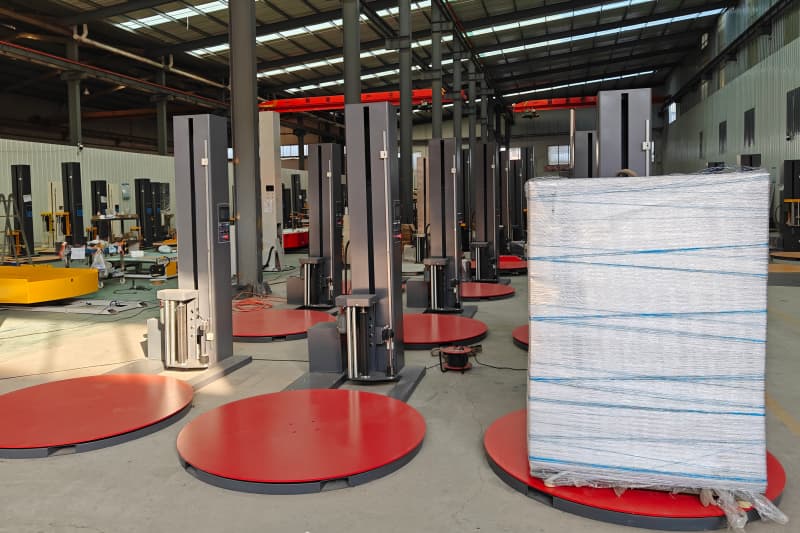
Let’s explore the critical steps, common errors, and scenario-specific recommendations to ensure your pallets are well-prepared for storage, transit, or delivery. Stick around to discover the pivotal role automation can play in streamlining this process while minimizing costs.
Why does load security matter when stretch wrapping a pallet?
Securing a load properly is essential to avoid product damage during transport. Improper wrapping can compromise efficiency.
Load security matters because it prevents goods from shifting or collapsing during transit.2 Stretch films layered with proper tension stabilize the load, reduce damage risks, and ensure cost-efficient material usage.
Stretch wrapping achieves two goals at once: it protects goods from external factors like dust and moisture3 while stabilizing the load to prevent breakage or shifting during handling. However, achieving this requires the right technique. Begin with a secure base wrap, apply consistent tension4, and ensure overlapping layers for uniform coverage.
Common mistakes during load wrapping
When I’ve consulted warehouse operators, I found that mistakes often stem from either rushing or trying to cut costs. Here are a few:
- Uneven tension: A loose film compromises load stability, while excessive tension risks tearing.
- Insufficient layering: Quick, single-layer wraps lack durability.
- Incorrect film quality: Using low-grade films to reduce costs often results in waste and poor adherence.
Should you use manual or automated stretch wrapping?
Choosing between manual and automated wrapping depends on your volume and the importance of load consistency.
Manual stretch wrapping is cost-effective and ideal for small-scale operations.5 Automated wrapping suits larger operations due to its efficiency, labor savings, and ability to stretch film optimally, often offering better long-term value for high-volume requirements.

Comparing manual and automatic methods
If your operation involves fewer pallets per day, manual wrapping might suffice. For occasional loads, manual wrapping is simple and does not require costly upfront investments. However, issues arise when tasks grow. Manual wrapping often leads to film waste due to inconsistent tension and layering.
Automated machines excel in high-volume settings. They use controlled tension settings and pre-stretch mechanisms that optimize film consumption6—achieving up to 300% stretch efficiency compared to manual efforts. Automation also drastically reduces labor time. For example, a client handling export goods recently transitioned from manual to automated wrapping and reported:
| Metric | Manual Wrapping | Automated Wrapping |
|---|---|---|
| Average pallets wrapped/hour | 10–12 | 25–30 |
| Film stretch efficiency (%) | ~100% | 250–300% |
| Labor time saved/week (hrs) | 0 | ~8 |
What impact does stretch film quality have on efficiency?
Stretch film quality significantly affects load stability, waste reduction, and cost-efficiency. Poor-quality films often lead to material waste and weaker wrapping.
High-quality stretch films with optimized tension settings enhance load stability7, minimize environmental waste8, and improve stretch efficiency, offering better protection for goods during transit.
Selecting the right stretch film
Not all stretch films are created equal. Some come with added elasticity, durability, or resistance to environmental factors. Choose films suited to your load type:
- Light loads: Lower gauge films suffice for weight under 500 kg.
- Heavy loads: Thicker films provide durability and resistance to punctures.
- Export pallets: Films offering moisture resistance ensure safe transit across varying climates.9
Premium stretch films combined with automated pre-stretch machines optimize costs by utilizing each meter more effectively—stretching it into 2.5 to 3 times its original length without overuse.
How can automation reduce labor and boost efficiency?
Transitioning to automation not only saves time but also cuts waste. Operators often overlook how automation balances upfront costs and long-term cost savings.
Automated stretch wrapping machines reduce hands-on labor by up to 80%10, increase wrapping speed, and improve consistency across the load, resulting in lower material costs and higher operational efficiency.
Case study: A warehouse’s journey to automation success
A small warehouse managing export pallets faced inefficiencies in manual wrapping. Labor costs for two dedicated operators totaled $900/month, with wrapping speed capped at 12 pallets/hour.
They invested in an entry-level stretch wrapping machine for just $6,500, seeing immediate benefits:
- Time efficiency: The machine wrapped 30 pallets/hour, requiring only one operator for oversight.
- Cost savings: Film stretch efficiency increased from ~100% to 250%, reducing material orders by 30%.
- Labor allocation: Freed one worker for other tasks, further enhancing productivity.
Though the initial investment seemed steep, total cost recovery occurred within nine months, proving automation’s efficiency.
Frequently Asked Questions
Can manual wrapping still be effective?
Yes, manual wrapping works well for small-scale operations or occasional loads. However, it can struggle with consistency, especially for high-volume tasks or heavier pallets.
What’s the recommended stretch film for export?
For export, opt for films offering moisture resistance and puncture durability. High-gauge films prevent tearing during transit and ensure better protection in varying climates.
How much film stretch is achievable with automation?
Automated machines can achieve 250–300% stretch efficiency, compared to roughly 100% in manual processes11. This means better cost-effectiveness and fewer material orders.
How long does it take to recoup costs on a stretch wrapping machine?
Typically, cost recovery happens in 9–12 months, depending on your operation's scale, labor cost reductions, and film savings.
Can entry-level machines handle light loads?
Yes, entry-level machines are sufficient for light and medium loads, offering a good balance of cost and efficiency for smaller warehouses or businesses.
Conclusion
Properly stretch wrapping a pallet is more than a technical skill—it’s a strategic choice involving load security, cost-efficiency, and operational optimization. Balancing manual methods with automation ensures optimal results, with automated machines excelling in high-volume operations due to superior film utilization, labor savings, and consistency. Whether you're securing export pallets or enhancing domestic workflows, the right approach can yield significant returns.
Ready to explore automated solutions? Let’s get started on finding the perfect stretch wrapping machine for your needs!
"Stretch wrap", https://en.wikipedia.org/wiki/Stretch_wrap. Encyclopedic overviews of stretch wrap report that machine films are often pre‑stretched in the range of roughly 150–300%, indicating that 250–300% falls within common machine capability. Evidence role: statistic; source type: encyclopedia. Supports: Automated stretch wrappers commonly achieve pre-stretch rates on the order of 250–300%.. Scope note: Specific pre‑stretch capability depends on the particular film and equipment. ↩
"Cargo Securement Rules | FMCSA", https://www.fmcsa.dot.gov/regulations/cargo-securement/cargo-securement-rules. Government cargo‑securement guidance explains that correctly secured loads are prevented from shifting or falling during transport, thereby mitigating damage and hazard risks. Evidence role: general_support; source type: government. Supports: Proper cargo securement prevents load shifting or collapse in transport, reducing damage and safety risks.. Scope note: Such guidance addresses vehicle cargo generally rather than stretch‑wrapped pallets specifically. ↩
"Stretch wrap", https://en.wikipedia.org/wiki/Stretch_wrap. Reference articles on stretch wrap describe that it offers protection against dust and moisture and contributes to load stabilization. Evidence role: mechanism; source type: encyclopedia. Supports: Stretch wrap provides protection from dust and some moisture while stabilizing unit loads.. Scope note: Stretch wrap is not a hermetic barrier, so moisture protection is limited. ↩
"The influence of stretch wrap containment force on load ...", https://research.fs.usda.gov/download/treesearch/62962.pdf. Professional unit‑load packaging guidance indicates that consistent film tension and adequate overlap are required to build and maintain containment force for stable stretch‑wrapped loads. Evidence role: expert_consensus; source type: institution. Supports: Packaging guidelines recommend consistent film tension and overlap to achieve and maintain adequate containment force.. Scope note: Recommended values for tension and overlap vary with film type and load characteristics. ↩
"Stretch wrap", https://en.wikipedia.org/wiki/Stretch_wrap. Reference discussions of stretch wrap commonly note that hand wrapping is used for lower volumes and machine wrapping for higher volumes due to efficiency and consistency. Evidence role: general_support; source type: encyclopedia. Supports: Manual/hand stretch wrapping is typically used for low-volume applications, while machine wrapping is used for higher volumes.. ↩
"Pilot Study of Stretch Film for Securing Palletized Loads - PMC", https://pmc.ncbi.nlm.nih.gov/articles/PMC12656129/. Experimental studies on unit‑load stretch wrapping report that powered pre‑stretch reduces film usage for a given containment force compared with non‑pre‑stretched application. Evidence role: mechanism; source type: research. Supports: Powered pre-stretch in machine wrapping reduces the quantity of film required per load while achieving required containment force.. Scope note: The magnitude of savings depends on film properties and machine settings. ↩
"Effect of Time and Temperature on Stretch Wrap", https://unitload.vt.edu/research/undergraduate-research/recent-undergraduate-research/undergraduate-research-temperature-stretchwrap.html. Peer‑reviewed packaging studies show that film mechanics and applied tension determine containment force, which is directly tied to unit load stability. Evidence role: mechanism; source type: research. Supports: Containment force—and thereby load stability—depends on film mechanical properties and the applied tension during wrapping.. ↩
"Reducing Food Waste Packaging", https://www.epa.gov/sites/default/files/2015-08/documents/reducing_wasted_food_pkg_tool.pdf. Environmental agencies identify source reduction as the most effective strategy to reduce packaging waste and associated impacts, supporting the benefit of using less stretch film. Evidence role: general_support; source type: government. Supports: Source reduction—using less packaging material—reduces waste generation and environmental impacts.. Scope note: This is a general principle of materials management and not specific to stretch film. ↩
"Moisture Transport - Building Science Education", https://bsesc.energy.gov/training-modules/moisture-transport. Government packaging specifications for export and storage call for moisture vapor barrier materials to mitigate humidity and climate-related damage during transport. Evidence role: general_support; source type: government. Supports: Specifications for export and long-term storage recommend moisture vapor barrier materials to protect goods in variable climates.. Scope note: These specifications address barrier packaging in general and may involve materials beyond conventional stretch wrap. ↩
"Ergonomics - Overview", http://www.osha.gov/ergonomics. Occupational safety guidance recommends mechanization and automation to reduce manual material handling demands, supporting substantial reductions in hands‑on labor relative to manual methods. Evidence role: general_support; source type: government. Supports: Mechanization/automation reduces manual material handling and associated labor time compared with hand processes.. Scope note: Such guidance supports the direction of effect but does not substantiate the specific 80% figure for stretch wrapping. ↩
"Stretch wrap", https://en.wikipedia.org/wiki/Stretch_wrap. Reference material on hand stretch films indicates typical manual elongation on the order of about 100% (doubling in length), consistent with the stated figure. Evidence role: statistic; source type: encyclopedia. Supports: Hand-applied stretch films are commonly elongated to around 100% during application.. Scope note: Actual elongation varies with operator technique and film grade. ↩