 Skip to content

Finding the right horizontal flow wrapper machine for small bakery or snack operations can be challenging, especially when managing frequent SKU changes across shifts. The decisive factor is not peak speed but changeover efficiency—ensuring smooth transitions between products in minimal time. Let me guide you through the practical parameters to evaluate for multi-SKU packaging success.
A horizontal flow wrapper machine tailored for bakery/snack operations should prioritize rapid changeover capabilities—achieving 3–5 product transitions per shift in 5–15 minutes with precise quick-change hardware and optimized line interfaces. Focus on defining a clear SKU envelope, employing recipe-based adjustments, and integrating compatible upstream/downstream systems to meet operational goals.

The secret to effective machine selection lies in designing around specific product envelopes and changeover goals. Below, I’ll cover essential considerations for hardware, recipe control, film compatibility, and integration strategies that save minutes and ensure stable operation.
Why define the SKU envelope, not a universal promise?
Problem: Many buyers want an “universal” machine that packages every type of product but struggle with efficiency when SKU variations exceed workable limits.
Solution: Instead of chasing universality, clearly define the product envelope: dimensions, surface properties, and preferred sealing style. Set expectations for changeover times upfront, and ensure the machine can consistently support the defined range without over-promising compatibility.
Defining the product envelope upfront keeps packaging machinery focused on realistic constraints, avoiding operational delays caused by misaligned size or material capabilities during frequent SKU shifts.
Dive deeper: Specific product envelope considerations
Successfully selecting an HFFS machine for multi-SKU operations requires upfront clarity on the following:
- Dimensions: Establish the length, width, and height range for your packaged items. For bakery/snack products, variations in single cookies, buns, or bars must fit within a bounded size range.
- Surface characteristics: Consider product rigidity, crumbly edges, oily textures, or coatings that might impact infeed handling and packaging seals.
- Packaging style: Determine if pillow packs, fin-seals, gussets, or any specialized designs are needed. Additional features like print marks must align with machine capabilities.
- Expected changeover times: Define what’s included (e.g., film swaps, forming set changes, recipe load adjustments, infeed tweaks)1 and set clear performance benchmarks (5–15 minutes).
Key takeaway: Make the SKU envelope a formal acceptance item during commissioning tests. An undefined envelope often leads to mismatched expectations and costly downtime.
Which quick-change hardware drives efficiency?
Problem: Lengthy and cumbersome manual adjustments are the biggest killers of changeover speed in multi-SKU bakery/snack lines.
Solution: Specify quick-change components that minimize downtime, focusing on tool-free adjustments and memory systems for repeatability.
Quick-lock components like forming sets and film mandrels can dramatically reduce changeover minutes, enabling higher utilization of HFFS machines under real-world conditions.
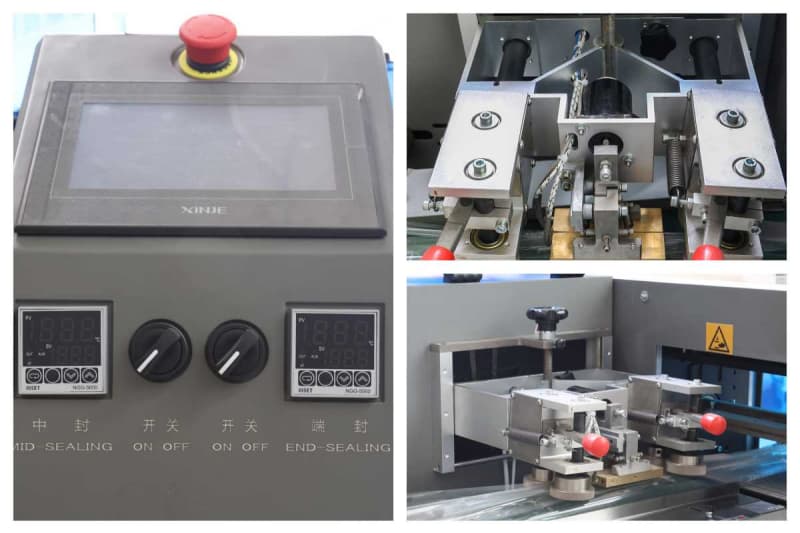
Dive deeper: Key quick-change components
From field experience, the components below offer maximum time savings for 3–5 changes per shift:
- Forming sets: Opt for no-tool-forming boxes with indexed guides to adjust pack width seamlessly.
- Sealing jaws and fin-seal wheels: Simplify jaw spacing through indexed spacer blocks instead of fully adjustable mechanisms, which add micro-tweak time.
- Infeed lugs and product guides: Quick-release infeed lugs and sliding guide rails ensure smooth positioning changes without extensive manual realignment.
- Film mandrel shafts and adapters: Invest in quick-lock shafts that speed up reel changes while keeping alignment consistent.
- HMI memory and indexing: Pre-configure settings (e.g., belt speeds, offsets, dwell times) in an intuitive recipe library to reduce operator errors during transitions.
Trade-off insight: Universal jaws or fully adjustable forming sets seem versatile but tend to complicate setup and hurt sealing quality. Align purchases to your SKU envelope for best results.
How does recipe control optimize changeovers?
Problem: Manual adjustments during changeovers often lead to repeated retries or higher scrap rates, adding unnecessary delays.
Solution: Embed recipe memory capabilities in the machine's HMI to automate adjustments. Include integration handshakes with upstream and downstream equipment2 for faster resets.
Recipe memory reduces trial-and-error during transitions, while intelligent handshakes between systems prevent re-tuning delays.
Dive deeper: Recipe-driven automation
An optimized recipe system can store and preload:
- Belt speeds for different product sizes.
- Jaw temperature settings based on film type.
- Film tension configurations specific to print marks or material thickness.
- Eye-mark offsets for consistent sealing position.
Additionally, define acceptance tests to lock in changeover success:
- Test scope: From last good pack of SKU A to first stable-good pack of SKU B (inclusive of film threading).
- Metrics: Scrap count tracking with a pre-agreed cap below your operational waste limit.
Integration handshake advice:
- Upstream feeders should handshake with simple signals (e.g., "product-present") to avoid frequent re-tuning.
- Downstream reject systems must align structurally with mechanical datum points to maintain precision.
When applied correctly, recipe control can cut operator time and eliminate unnecessary readjustments.
How should film compatibility be addressed during changeovers?
Problem: Switching multiple film families (e.g., OPP, PE, paper laminates) during shifts increases risk and eats into changeover minutes.
Solution: Standardize film types and widths where possible. If variation is unavoidable, specify dual-zone heating elements and modular jaws optimized for specific films3.
Film compatibility plays a central role in HFFS machine design. Without proper planning, seal integrity suffers, resulting in wasted materials.

Dive deeper: Film and seal considerations
Key rules for managing film changes effectively:
- Film families: Standardize to one dominant type for reduced risks (e.g., limit changes between OPP/CPP and PE laminates).
- Quick-change jaws: Use heat-compatible profiles optimized for differing thickness or seal layers if material transitions are unavoidable.
- Film width: Avoid frequent multi-width shifts by maintaining a fixed size range.
- Integration with heating/motion controls: Specify machines with clear reference scales for tension, heat zones, and print alignment tweaks.
Do not compromise seal quality to speed up changeovers. If your products rely on strong sealing (e.g., bakery pillow packs), prioritize reliability during multi-SKU transitions.
Frequently Asked Questions
How quickly can HFFS machines manage changeovers for bakery lines?
Typically, an optimized horizontal flow wrapper can complete product changeovers within 5–15 minutes, including film reel swaps, settings adjustments, and forming box changes.
What types of films work best with bakery products?
Films such as OPP/CPP laminates are commonly used for bakery/snack items due to their good sealability and printability. PE films may require specialized heating profiles for consistency.
Can universal jaws handle multi-SKU operations reliably?
While universal jaws promise flexibility, they often increase micro-adjustment time and compromise sealing quality. Align forming/jaw configurations with your specific product envelope for better efficiency.
Conclusion
A horizontal flow wrapper machine can significantly enhance packaging operations in bakery/snack lines, especially under multi-SKU demands. By focusing on defining the product envelope, specifying quick-change hardware, leveraging recipe memory, and managing film families effectively, you can achieve smooth transitions—meeting 3–5 changeovers per shift in 5–15 minutes.
Ready to select the perfect HFFS machine? Submit these details to start your evaluation: product dimensions, pack style, film family, infeed method and throughput, changeover targets, required modules, available layout space, and integration signals. Include a proposed Factory Acceptance Test (FAT) item4: “A→B changeover within 5–15 minutes to first stable-good pack,” with scrap limits specified. Let’s make your multi-SKU operations effortless.
"Quick Changeover Best Practices For Modern ...", https://www.bwpackaging.com/blog/quick-changeover-best-practices-for-modern-packaging-lines. Educational resources on operational planning emphasize that clear changeover benchmarks reduce downtime and improve machine utilization. Evidence role: mechanism; source type: education. Supports: Supports the claim that defining changeover scope upfront improves operational efficiency.. Scope note: The evidence may focus on general operational principles rather than specific case studies in bakery/snack packaging. ↩
"How to Ensure Maximum Throughput – Part 2", https://pearsonpkg.com/resources/secondary-packaging-system-integration-how-to-ensure-maximum-throughput-part-2/. Research on automated packaging systems shows that integration handshakes between equipment streamline transitions and reduce manual adjustments. Evidence role: mechanism; source type: research. Supports: Supports the claim that integration handshakes reduce re-tuning delays during changeovers.. Scope note: The evidence may focus on specific automation systems and may not universally apply to all HFFS configurations. ↩
"Dual Zone Mini Split Systems", https://hvacdirect.com/ductless-mini-splits/dual-zone-ductless-mini-split-systems.html?srsltid=AYCX9vKq-wiwGcnAX33pWdVmDmMjTpMfBraL5T9f--LWf6ffpDYlL7Ry. Studies on packaging machinery design show that dual-zone heating and modular jaws enhance seal quality, particularly during transitions between different film types. Evidence role: mechanism; source type: research. Supports: Supports the claim that dual-zone heating elements and modular jaws improve seal integrity during changeovers.. Scope note: The findings may depend on specific machine configurations and may not universally apply to all HFFS systems. ↩
"Commissioning Guide - Packaging Machinery FAT, SAT", https://machineryautomate.com/packaging-machinery-fat-sat-commissioning.html. Educational resources on machinery commissioning recommend including FAT items to validate performance benchmarks and ensure operational readiness. Evidence role: case_reference; source type: education. Supports: Supports the claim that FAT items improve commissioning success in packaging operations.. Scope note: The evidence may focus on general commissioning practices rather than specific applications in bakery/snack packaging. ↩


