Skip to content

Choosing the right food packaging machines can be daunting without understanding how each type performs specific tasks. Many manufacturers mistakenly assume a single machine can meet all their needs or misalign production capacity.1 Let’s explore the most common food packaging machines and how they match diverse operational requirements.
Food packaging relies on specialized machines designed for individual tasks, such as wrapping, sealing, and strapping products according to production needs and packaging formats. Selecting the right machine requires careful consideration of food type, packaging materials, and operational throughput.
Understanding the typical equipment used across the food packaging sector—and knowing how to select the right ones—can save time, reduce waste, and ensure better outcomes for your production process. Below, I’ll break down the primary categories and their optimal use cases.
What is the role of pouch and pillow packing machines?
Snack food packaging always presents unique challenges—particularly when dealing with items that require airtight sealing or individual portion sizes.
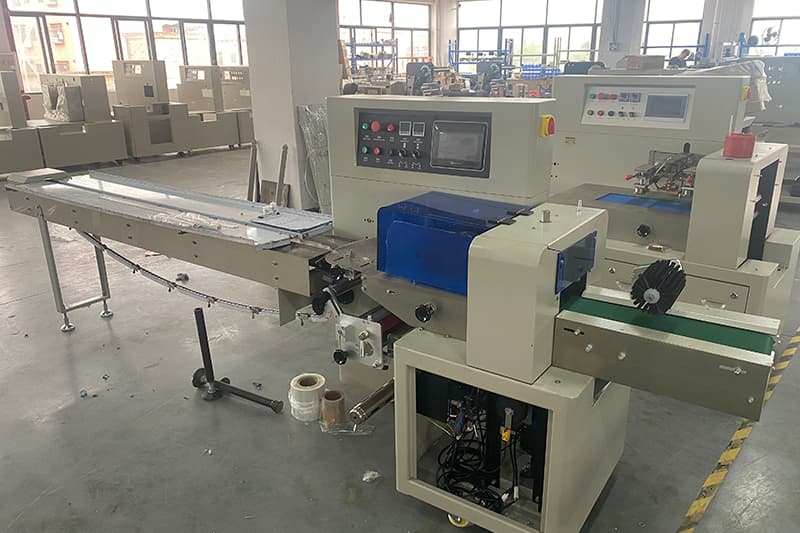
Pouch and pillow packing machines are specialized for bagging individual snacks, seasonings, or other small products that require precision and speed. They are effective for items like chips, nuts, or powdered foods.
Dive deeper into automated snack packaging
Pouch packing machines are widely chosen for small, portable, sealed food packages. These machines typically include features like volumetric or gravity fillers to streamline the process. Pillow packing machines, on the other hand, excel in wrapping items efficiently and making them aesthetically appealing for retail settings. For example:
- Speed: Both machines can operate at speeds up to 100 packs per minute, depending on the model. High-speed operation ensures throughput aligns with high-demand production environments.
- Airtight Packaging: The sealing capabilities maintain food quality by minimizing exposure to moisture or contaminants.
- Versatility: Adjustments allow handling various bag sizes, weights, and packaging materials (e.g., laminated films, plastic).
Common use cases:
- Potato chips or tortilla chips in smaller bags for retail sales.
- Packaged powdered food (spices or flavoring).
- Lightweight goods requiring pillow-style pouches for ease of stacking.
The key is realizing that these machines are optimal for limited-size packaging but are less suited for bulk products requiring large-scale wrap solutions such as palletized stacks.
Why are carton sealing machines essential in bulk packaging?
Many food manufacturers skip automated sealing setups, thinking manual carton tape application suffices. Over time, though, those solutions lead to inefficiencies, increased labor, and inconsistent packaging.
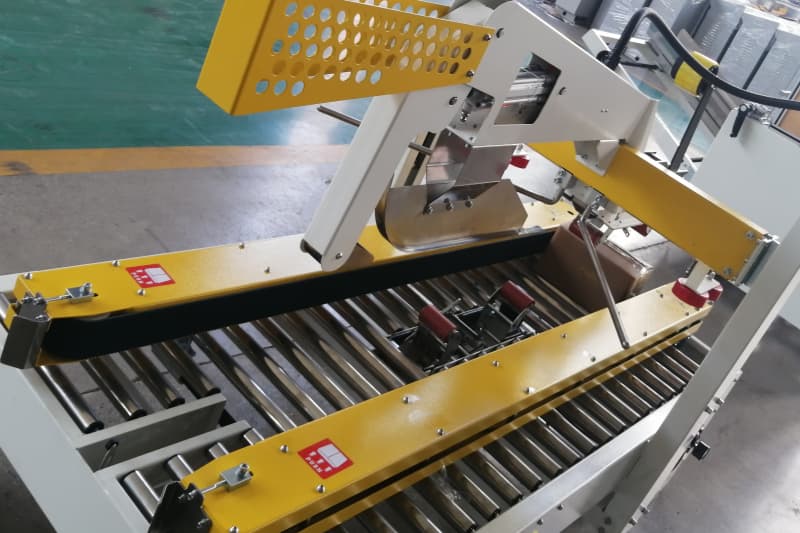
Carton sealing machines provide fast, consistent closure for large or small cartons in high-volume operations. They are an ideal choice for food manufacturers transporting packaged food within secondary packaging.
Dive deeper into sealing operations
Carton sealing machines come equipped to securely tape cartons or boxes with uniform adhesive application. Advanced setups combine these sealing stations with case erecting machines to form a semi-automated secondary packaging system. Avoiding manual effort frees up labor to focus on other production aspects.
Key benefits:
- Speed and throughput: Machines ensure uniform sealing of hundreds of units per hour without fatigue.
- Durability: Proper adhesion reduces risks of package opening during transportation or storage.2
- Custom adaptability: Adjustable sizes allow sealing lines to support cartons of varying dimensions for food product batches.
A great example is a frozen food manufacturer shipping products to distributors. Their bulk cartons are sealed automatically, while small-scale adjustments allow handling cartons of different standard stock-keeping sizes.
Remember that efficient sealing complements packaging results—it avoids waste but won't compensate for improperly sized cartons upstream in production.
How do stretch wrapping machines optimize logistics?
Packaging stacked goods properly ensures stability during transport and protects them from external damage, whether inside warehouses or shipping containers.
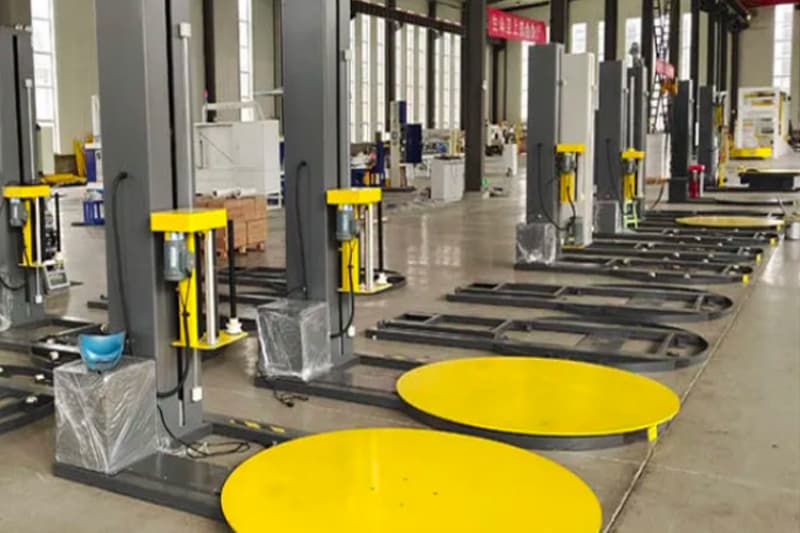
Stretch wrapping machines are particularly suitable for securing stacked goods—like large food boxes—for transport or long-term storage. They apply consistent stretch films to stabilize pallets or oversized packaging.
Dive deeper into wrap automation
Stretch wrapping machines improve the operational standards for food manufacturers handling high-volume loads. These machines are capable of consistent, automated wrapping speeds to secure large pallets with layers that reduce slippage.
Advantages:
- Material adaptability: Different stretch films offer choices based on load and durability needs.
- Space efficiency: Secure stacking ensures minimum waste of storage capacity.
- Reduced labor reliance: Automation lowers the need for manual tying or wrapping.
Situations demanding stretch film:
- Transportation-ready pallets in distribution channels.
- Stacks heading into longer-term storage awaiting gradual distribution phases.
Selecting stretch wrapping machines means calculating your pallet size and film load requirements carefully—overusing materials on misguided assumptions can increase operational waste.
How can integrated production lines enhance food packaging?
The misunderstanding many food manufacturers hold is believing standalone machines sufficiently solve productivity bottlenecks. The reality of scaling operations reveals inefficiency when multi-machine performance isn’t synchronized.
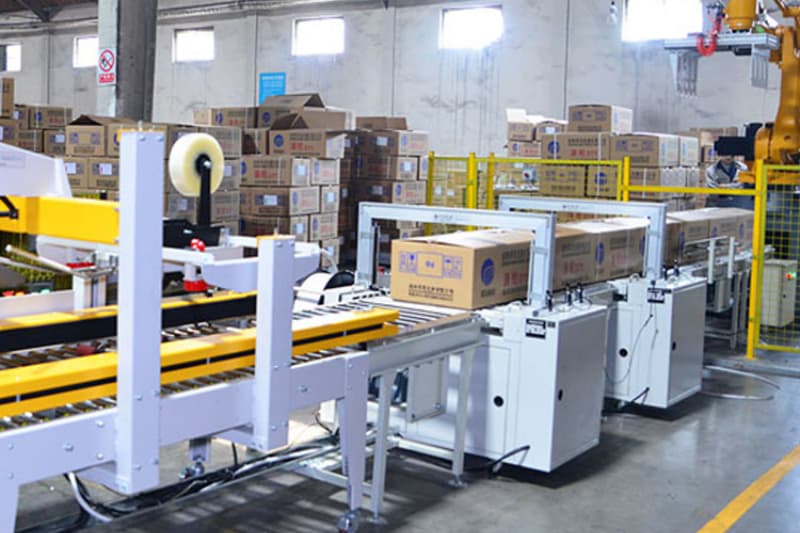
Integrated production lines combine multiple machines to handle case erecting, filling, sealing, inspection, and strapping tasks in one cohesive workflow. These systems optimize speed, consistency, and throughput results.
Dive deeper into automation synergy
Planning integrated workflows begins by mapping your industrial environment around bottleneck analysis. The focus should lie on modular scalability—optimizing each segment's specific contributions.
Typical machine line partnerships:
- Case erecting machines prepare containers efficiently for product feeding.
- Conveyor belts and packing machines regulate product-in-box precision alternately.
- Carton sealing units finalize wrapping before dispatch areas.
- Strapping machines secure packed goods intended for regional transportation routes.
Benefits:
- Advanced inspection controllers ensure fault reductions.3
- Improved operator efficiency stems from reduced machine-to-machine delays.
- Accurate operating sequence adjustments ensure smoother transitions.
Highly specific integrations apply where throughput must match stockpile handling models (e.g., cross-continental frozen food shipment).4
Frequently Asked Questions
What determines the choice of a food packaging machine?
Determine your choice based on product type, packaging goals (e.g., airtightness or loose sealing), production scale, and budget. Factor in how specialized equipment aligns with these needs and whether integration into existing lines is feasible.
Are manual packaging setups still relevant for food businesses?
Manual setups are acceptable for low-volume production or specialized, niche goods. However, they lack scalability, efficiency, and reliability, making them unsuitable for larger manufacturers.
How can I estimate production capacity requirements?
Assess product demand in units per hour, combined with flexibility margins for growth projections. Match this demand to the machine’s rated capacity to avoid costly underperformance or over-investment.
Conclusion
Food packaging relies on specialized machinery tailored to your unique needs—whether pouch packing snacks or stretch wrapping pallets. Misjudging production capacity or overgeneralizing machine applications can lead to inefficiencies in cost and operation.5 I recommend working closely with experienced suppliers to configure equipment and integrate production lines effectively. To explore tailored solutions, reach out to discuss your specific requirements today!
"Case study on biscuit wrappers", https://one.oecd.org/document/ENV/CBC/MONO(2021)32/En/pdf. A study on food manufacturing practices highlights that misaligned production capacity often stems from overestimating the versatility of single machines, leading to operational inefficiencies. Evidence role: general_support; source type: research. Supports: The prevalence of misconceptions among manufacturers regarding the versatility of food packaging machines.. Scope note: The study may focus on specific regions or industries, limiting its general applicability. ↩
"Corrugated board packaging with innovative design for ...", https://bioresources.cnr.ncsu.edu/resources/corrugated-board-packaging-with-innovative-design-for-enhanced-durability-during-transport/. A paper on packaging durability discusses how adhesion quality directly influences the integrity of sealed cartons during shipping. Evidence role: mechanism; source type: paper. Supports: The role of proper adhesion in reducing package opening risks during transport and storage.. Scope note: May not address specific adhesive types or machine models. ↩
"A Robust Technique to Perform Product Quality Inspection", https://scholarworks.utrgv.edu/cgi/viewcontent.cgi?article=1947&context=etd. A paper on automated inspection systems explains how advanced controllers minimize errors in food packaging workflows. Evidence role: mechanism; source type: paper. Supports: The role of inspection controllers in reducing faults in packaging processes.. Scope note: May not address specific controller technologies or fault types. ↩
"A CROSS CASE COMPARISON OF 11 CASE STUDIES", https://agsci.psu.edu/research/food-security/publications/supply-chain-case-studies/cross-case-comparison-of-11-case-studies. Institutional case studies on frozen food logistics highlight the importance of integrated production lines for throughput alignment in cross-continental shipments. Evidence role: case_reference; source type: institution. Supports: The necessity of specific integrations for aligning throughput with stockpile handling models in frozen food logistics.. Scope note: Case studies may focus on specific regions or shipment types. ↩
"Challenges and limitations of synthetic minority oversampling ...", https://pmc.ncbi.nlm.nih.gov/articles/PMC10789107/. Research on food packaging systems identifies common inefficiencies stemming from misaligned production capacity and overgeneralized machine applications. Evidence role: general_support; source type: research. Supports: The operational and cost inefficiencies caused by misjudging production capacity or overgeneralizing machine applications.. Scope note: Findings may not address all machine types or production scales. ↩